
25 Mar 5 Biggest AI Mistakes Small Businesses Are Making
These AI Mistakes Are Costing You Time and Clarity
AI has quickly become one of the most talked about tools in business, and if you are a coach, entrepreneur, or professional trying to save time and grow more efficiently, chances are you have already tried it. On the surface it feels like the answer to everything. Create faster. Work smarter. Do more in less time. Sounds like a dream, right?
Yet for many small business owners, the reality feels very different.
Instead of clarity, there is confusion. Instead of momentum, there is inconsistency. Instead of saving time, there is a growing sense of overwhelm that makes you wonder if AI is even worth the effort. The truth is, these are avoidable AI mistakes, and once you see them for what they are, things start to shift.
This is not because AI does not work. It absolutely does. The problem is that it is often being used without the right structure in place. When AI gets layered on top of scattered systems, it tends to amplify the mess instead of solving it. Think of it like putting a turbo engine in a car with no steering wheel. You will move fast, but not in the direction you need to go.
Recent research from the Digital Applied Small Business AI Adoption Guide found that while roughly 68% of small businesses now use AI tools regularly, the vast majority lack formal policies, training programs, or measurement frameworks. That means most business owners are winging it, and that is where AI mistakes start piling up.
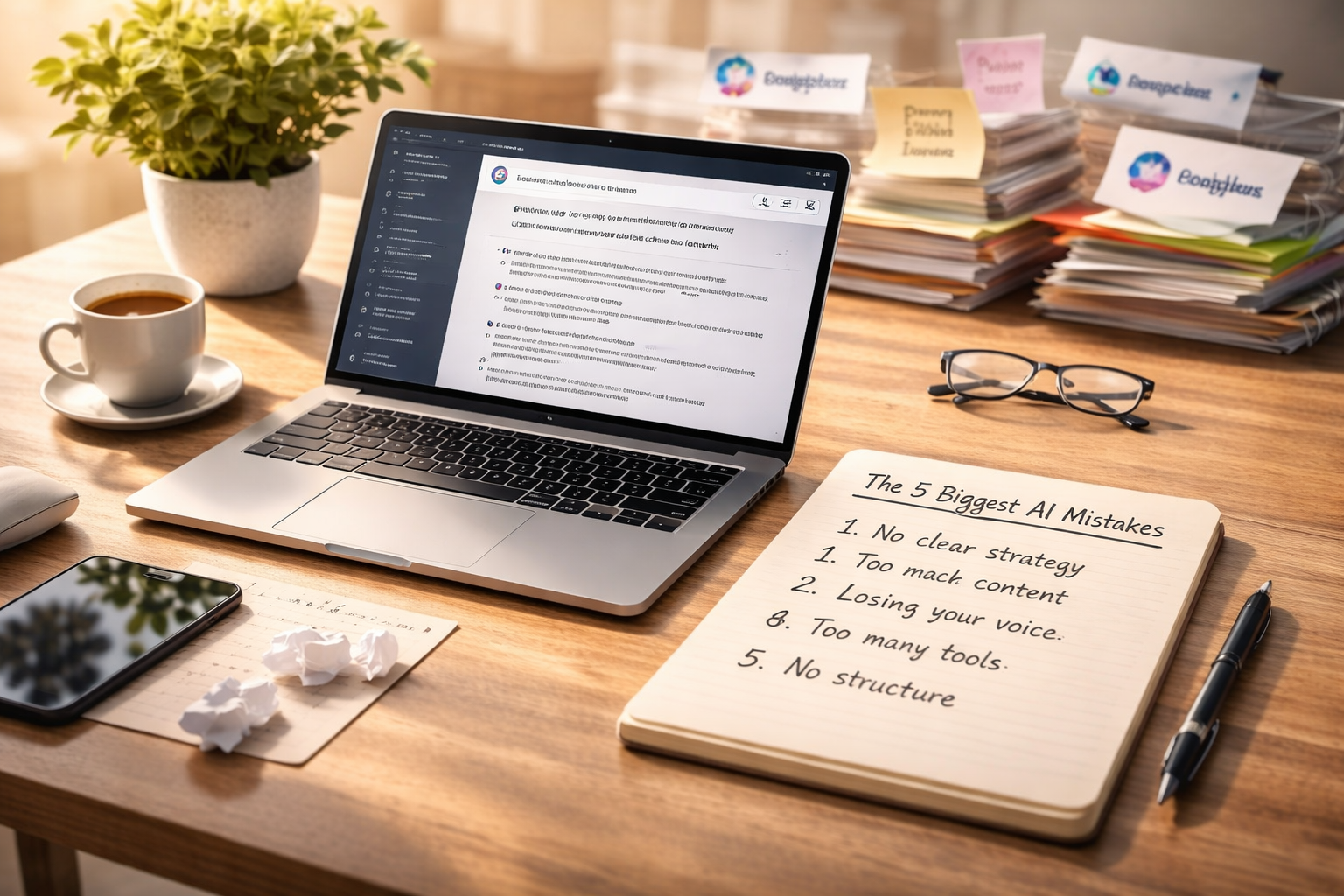
Here are five of the most common small business AI mistakes, along with a better way to approach each one so you can stop spinning your wheels and start building real momentum.
1. Using AI Without a Clear Purpose
One of the biggest AI mistakes small business owners make is jumping in without a clear reason for using it. You hear everyone talking about ChatGPT or the latest AI tool, so you sign up, poke around for a bit, and then wonder why nothing feels different. Sound familiar?
Without a defined role, AI quickly turns into another open tab, another distraction, and another place where ideas start but do not lead anywhere. That is not a technology problem. That is a clarity problem.
Working with clients over the years has shown me that the ones who get real results from AI are the ones who come in knowing exactly what they need it to do. Whether that is drafting email campaigns, organizing their content calendar, or streamlining client onboarding, clarity around purpose turns AI into a useful tool instead of added noise.
A better approach: Before you open any AI tool, write down the one task you want it to support this week. Just one. Get that working smoothly before adding anything else. You will be amazed at how much more productive you become when AI has a job description instead of an open invitation.
2. Creating More Content Instead of Better Systems
AI makes it incredibly easy to generate content, which often leads to the assumption that more content means better results. More posts. More emails. More ideas flying everywhere. But here is what nobody tells you: without a system behind it, more content simply creates more work.
Content that is not connected, reused, or part of a larger strategy does not build momentum. It creates inconsistency, and that is one of the most frustrating AI mistakes because you feel like you are doing so much, yet the results do not match the effort.
The business owners who are seeing real growth have learned that one good piece of content can fuel an entire week. A single blog post can become an email, a social media post, a conversation starter, and a client resource. That is how simple systems work, and it is exactly what we explored in You Do Not Need More Content, You Need Simple Systems.
A better approach: Focus on building a repeatable content system before you ask AI to create a single thing. When one idea can support multiple touchpoints in your business, you stop chasing content and start creating with intention. That shift alone can save you hours every week.
3. Relying on AI Instead of Your Own Voice
This one hits close to home, and it is one of the AI mistakes that can quietly do the most damage to your brand. AI can generate polished content quickly, but it does not have your experiences, your stories, or the way you connect with your audience. When everything is generated and nothing is refined, your message starts to sound like everyone else’s, and your audience can feel the difference even if they cannot put their finger on it.
Your people are not following you because of perfectly written paragraphs. They are following you because of who you are, what you have lived through, and how you make them feel like they can do this too. No AI can replicate that.
A better approach: Use AI as a starting point, never the final result. Let it help you organize your thoughts, draft a structure, or spark new angles. But always, always bring your voice back into the process. Read what it gives you out loud. If it does not sound like something you would actually say to a client or friend, rewrite it until it does. Your authenticity is your competitive advantage, and that is something no tool can manufacture.
4. Jumping Between Too Many AI Tools
New AI tools pop up practically every day, and it is tempting to believe you need to try all of them. One tool for writing, another for images, another for automation, another for planning. Before you know it, you have six subscriptions and cannot remember which tool does what.
What actually happens is not increased efficiency but fragmentation. Ideas get spread across platforms, workflows become inconsistent, and nothing feels fully complete. This is one of those AI mistakes that sneaks up on you because each individual tool seems helpful, but together they create chaos.
A recent Harvard Business Review analysis on AI adoption reinforced what many of us already know from experience: performance gains plateau when tools are adopted without integration into how work actually gets done. The same principle applies whether you are a Fortune 500 company or a solopreneur running your business from your home office.
A better approach: Choose two or three tools that align with how you actually work and commit to using them consistently. Master those before even thinking about adding more. The goal is not to use more tools. The goal is to use the right ones well, and to let them support the systems you have already built.
5. Expecting Results Without Structure
AI can speed things up, but it cannot replace the need for structure in your business. Without a clear path for how your ideas turn into content, how your content turns into engagement, and how that engagement turns into paying clients, results will always feel inconsistent. This is one of the most overlooked AI mistakes, and honestly, it is the one that holds the most people back.
Here is what that looks like in real life. You create a great blog post but have no email sequence connected to it. You post on social media but have no call to action that leads anywhere. You are busy, you are creating, but the pieces are not working together. AI did not cause that problem, but it sure will not fix it either.
According to a March 2026 Pax8 survey, small businesses are adopting AI faster than they are building strategies to manage it. That gap between adoption and strategy is exactly where frustration lives.
A better approach: Create a simple, repeatable path in your business. Know how people find you, how they learn from you, and how they move forward with you. When you have that structure in place, AI becomes the engine that keeps it all running smoothly instead of another loose end that needs managing.
Bringing It All Together
Every one of these AI mistakes comes back to the same root issue: trying to do more before getting clear on what actually works. Success does not come from adding more tools, more content, or more hours to your week. It comes from building the right structure so your work can move forward with intention and purpose.
When AI is used within that kind of structure, something beautiful happens. It becomes a powerful support system instead of another source of overwhelm. It helps you stay consistent without feeling scattered, productive without feeling rushed, and focused without feeling restricted. That is the sweet spot where technology actually serves the life and business you are building.
Real momentum does not come from doing more. It comes from allowing what you are already doing to work together in a way that feels aligned and sustainable. That is what a balanced life and biz looks like in action, and it is absolutely within your reach.
Take heart and remember, the goal is not perfection. The goal is progress with purpose. Start where you are, fix what is not working, and let everything else build from there. You have got this 🙌🏽
Continuing Your AI Journey
Ready to put this into action in a way that actually fits your workflow? Schedule Your FREE AI Strategy Session and get guidance tailored to your business. No cookie cutter plans, just real support for where you are right now.
These AI mistakes are just the beginning of a much bigger conversation. Be sure to explore the full AI Authority Series for more insights on using AI with clarity and confidence.
Stay productive while creating a Balanced Life and Biz by downloading the FREE Guide:
The Work Well, Live Well Toolkit

De Harris is the founder of AllBizWeb Marketing, with 22+ years of experience helping business owners bring strategy, marketing, websites, AI, and everyday systems together so the business actually works, without piling on more complexity to get there. Her goal is simple: help people move forward with a little more clarity, a little more confidence, and a more Balanced Life & Biz »

Sorry, the comment form is closed at this time.